World War II
The Good ShepherdIn the novel’s wartime setting, World War II is experienced less as a distant chronology than as a succession of urgent calculations at sea. Allied escorts must protect a convoy while German submarines gather information, coordinate, and threaten its course. Reports are incomplete, ships and fuel are limited, and even a sound decision can expose other vessels to danger. The war’s defining pressure is the distance between what commanders know and what they must decide before time runs out.
The convoy war at sea
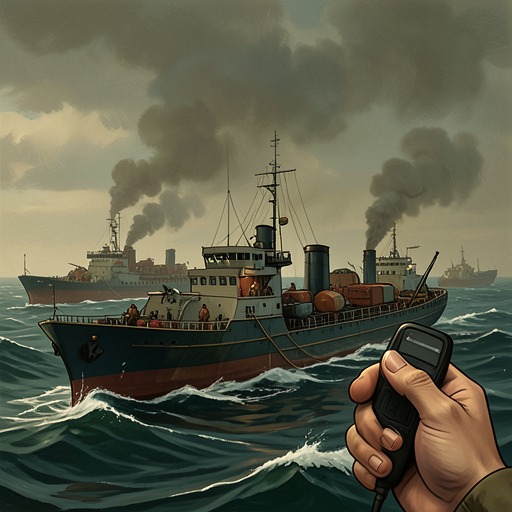
The North Atlantic convoy is a moving formation whose protection depends on a small escort screen covering a very wide area. When James reports a distant contact, Krause has to weigh the possibility of a U-boat against the cost of detaching an escort. James is three miles from the convoy, and a search could leave gaps in the screen through which other submarines might pass. If the contact is false, the ship will still spend fuel at high speed and then have to catch up with a convoy continuing along its route. If the contact is real and left alone, the danger remains. Neither choice offers safety without cost.
The account makes the convoy’s movement part of the tactical problem. A change of course is due in fourteen minutes, and that turn will take the convoy away from the suspected submarine. Yet a later warning places Keeling near the position of a U-boat concentration. By then, the convoy is closed up and moving with considerable momentum; transmitting a new order would be quick, but carrying it to every ship and ensuring it was understood would take longer. An unscheduled turn could also produce disorder and straggling. The war at sea is therefore fought not only by weapons, but through formation, timing, and the difficulty of moving many ships together.
Decisions under incomplete information
The reports available to the escorts vary in certainty. James’s contact may or may not indicate a submarine. A high-frequency direction-finding report is more definite: a foreign transmission is bearing nearly along the convoy’s path, suggesting a U-boat fifteen to twenty miles away. Even then, the report locates a transmission rather than resolving every question about the submarine’s position or intentions. Krause orders Keeling to run it down, but the threat still has to be found and approached through search.
When a submarine disappears from view, several explanations remain possible. It may have sighted Keeling first, have new radar, have received the convoy’s course, or simply have gone below the surface as a routine action. The narrative refuses to turn uncertainty into knowledge after the fact: the immediate task is to keep an open mind, remember that a submarine is believed to be ahead, and act before its possible area of movement expands. The search problem itself grows with time. A submarine could travel a mile in ten minutes, while the area requiring examination could expand from several square miles to a hundred square miles in an hour. Delay is thus not neutral; it enlarges the uncertainty the escorts must manage.
Allied coordination and communication
The convoy’s defense depends on cooperation among ships and national services, but that cooperation is also exposed to judgment and scrutiny. Krause is an American officer commanding an Allied escort, while the other captains have years of wartime experience. His choice about whether to authorize James to attack may affect the convoy’s safety, the confidence of another navy’s officers, and the goodwill on which Allied cooperation depends. Those political and professional consequences cannot be calculated like fuel consumption, but they add weight to the decision rather than supplying a clear answer.
Communication brings its own hazards. Later, foreign-language transmissions indicate that U-boats are communicating ahead of the convoy, perhaps coordinating their plans or reporting to Dönitz. At the same time, the escorts receive an Admiralty warning that identifies an enemy concentration and recommends a radical change of course southward. The message is already two hours old when it reaches Keeling, illustrating how quickly a warning can lose practical value while passing through a wartime system. Much later, another message arrives badly scrambled: its readable fragments report that reinforcements have been dispatched, identify an escort group captain, and refer to expected aircraft operations. Help is promised, but the damaged text leaves the immediate situation only partly clarified.
Loss, fuel, and the cost of protection
Convoy defense is constrained by fuel as well as by enemy action. Detaching a ship for a prolonged search may require hours of high-speed steaming, and the ship must still return to a convoy that has continued without it. These costs become more acute after an attack. As Cadena reports a speed of eleven and a half knots, a torpedoed merchant ship is sinking and the rescued crew’s lifeboats are visible near the wreck. Krause does not know how many people died in the strike. He has to turn Keeling back to pressing escort duties, including changing course because a submarine may still be within torpedo range. The loss cannot be allowed to suspend the defense, even though its consequences remain unresolved.
The same conflict persists when Viktor is disabled and under tow. Cadena can make only four knots, while Keeling must circle at a speed that maintains a sonar guard. The convoy moves farther ahead with every passing hour, and it may be days before Viktor reaches port. Keeling’s fuel will become urgent; Dodge and James may not have enough oil to reach Londonderry. The need to seek assistance from London therefore collides with the requirement for radio silence. A transmission could alert German monitoring stations that the convoy is in serious trouble and prompt Dönitz to direct more submarines against it. It could also tell the submarine captain who attacked Viktor that the torpedo struck home. Krause judges that help is essential, but considers delaying the message until one or two in the morning to reduce the time available for an attack before air cover might arrive at dawn. In this setting, waiting is itself a tactical choice.
War’s reach beyond the bridge
The wartime burden extends beyond immediate operations into Krause’s private history. His recollection of a broken marriage includes the service’s judgment that he was to be retained without promotion, his separation from Evelyn, and his request for assignment to the Atlantic seaboard, away from Southern California and Coronado. The account places that personal rupture beside the larger conditions of the war: chance has shaped his family history, career, and command, while political developments in Germany and Japan have helped create the conflict in which his duties now lie. The personal and military timelines meet in the same sense that events cannot be neatly undone once they have happened.
This portrayal does not make the war a simple contest between certainty and error. The escorts act on reports that may be incomplete or delayed; a course change can protect one part of the convoy while disrupting another; a rescue can save a ship’s company while leaving the convoy less well guarded. Even cooperation depends on decisions that can be second-guessed across national lines. World War II, as rendered through these episodes, is a sustained test of responsibility under pressure: the danger is immediate, the information provisional, and the consequences of each choice carried by people and ships beyond the decision-maker’s view.